Mike!
Here is the man who did the most for me in Israel, and who left an indelible impression with his calmness, advice, humor, knowledge, confidence, and wisdom.
But meeting him is still a whole day away, a day, however, already illuminated by his experience. And in the Negev desert you can hardly ride at random: the military scurry about here and there; a barrel near the ruins of a hut means a training target, and on weekdays you might get caught under artillery fire. I connected with Mike on the couchsurfing site for bike maniacs https://warmshowers.org, and he's the one who told me how to get to Revivim safe and sound.
My restless nature, forever thirsting for life and impressions, forced me to run ahead of myself, but now my mind leaps back to square one, and the day starts in all its warm velo-magnificence.
First – a bike shop, the only one that turned up on Google Maps. The latter saved me more than once or twice, mobile internet came in totally handy!
Interestingly, the inner tube I bought was self-sealing, which I discovered only some time later. Mike later told me that it works quite well, and small punctures heal perfectly on their own – magic! But it also has a fatal flaw – more decent-sized holes will stay forever – you can't patch them manually, the green goo from inside the tube that fills small holes eats away the glue on the patches, should you wish to use them.

A mountain biker will find off-road anywhere
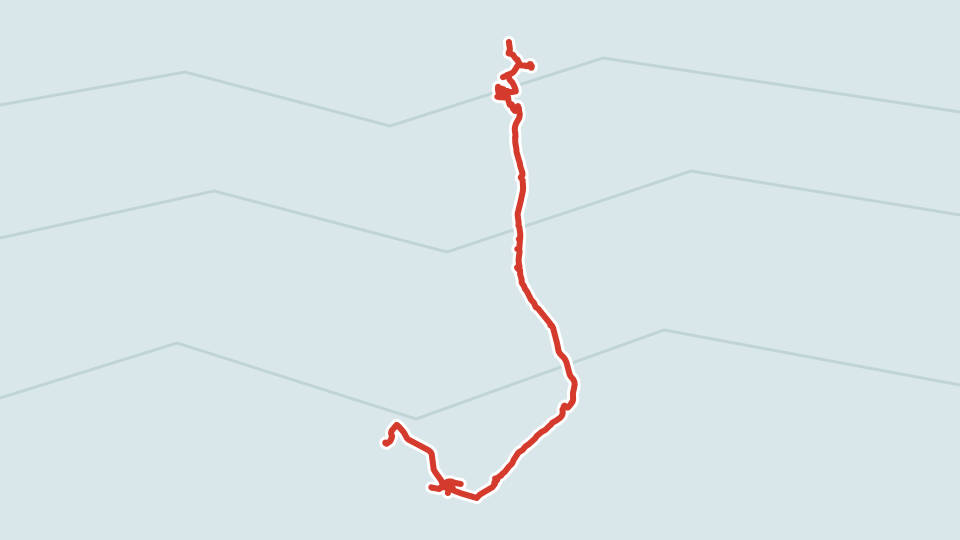
On Mike's advice I rode out of Beersheba along one of the three transport arteries connecting the north and south of the Negev; that is, Beersheba and the pampered resort of Eilat. The western one - near Egypt, to ride there, you need permission from the omnipresent army, and the eastern one – near the Dead Sea, but the most picturesque one – through the center, and that's the one I chose.

For some reason GPS led me to this gate as an attraction. Check it out!

There's nothing dearer to a cyclist's soul than dusty dirt roads

The army is everywhere, monuments to it are also not uncommon
Local merchants clearly paid off the creators of my GPS (Sygic for Android), it led me to a supermarket as an attraction. Well, I'm not discouraged – let's use this place as an observation point to show you a panorama of the city I just left.


Holes for ventilation, a roof for the sun, metal – one of the types of bus stops in Israel. The display board isn't electronic yet

Bike path
Thanks to Mike's advice, I rode a fair chunk along the gradually built bike path between Beersheba and Sde Boker. Interestingly, intersections in Israel often have names related to settlements that once existed there. I turned onto the path near Ohalim. I think it's a great practice – everything should be given a beautiful name, to improve navigation and increase cultural diversity. For geek-nerds you could also provide a universal number in small print, but that's probably overkill.

Occasionally there's a tree or two, a sort of mini-oasis
The oases disappointed me a bit: they are just as pale and plain as the surrounding reality (not that I'm complaining about the desert). I expected it to be like in a game – fountains where young maidens in burqas fan sheikhs with ostrich fans, baskets of fruit and camel caravans nearby.

Instead of this magnificence – a prosaic shepherd with a herd of goats

Or an oil refinery/power plant/other technical structure

Heat all around, not a cloud, the temperature is probably about 25 degrees
The Israeli people have only two friends – the Air Force and the Army!

The former

The latter

Therefore we must honor them by installing a large number of reinforced concrete sculptural constructions

This creepy monster pounced on me right in the middle of the road, I almost fell off my bike

And now even road markings have appeared
One of the secrets of the Israelis' success in turning the desert into a blooming garden is drip irrigation. A separate hose is routed to each of these palm trees, delivering the exact amount of water right to the roots. The Negev desert didn't belong to Israel at one point, and the first settlers had the right to create only "experimental farms." Sometime later, a UN commission arrived in Revivim for the final resolution of the Jewish question. Instead of sand and stones, they found flower beds, fruit trees, and hardworking farmers content with life. Jaws dropped, hands moved on their own, signing the papers transferring the Negev to the ownership of the newly emerged state to continue these favorable processes.

The grove was made by the local oil refinery, as a sign of status and a symbol of care for people and the environment

Drip irrigation is everything

A wonderful rest stop with a pillar for bike repairs. Civilization!

In theory there should also be water for washing and drinking, but there was a slight hiccup here

Guava drink – best bought with your eyes closed, so you don't have a heart attack from the prices

The Guava herself

On Mike's advice, I turned onto the old highway

Tunnels under the freeway
During the rainy season – from autumn to spring – there are floods in the desert, the tunnels here are more for the safety of the highway than for the animals.

In Golda Meir Park the vegetation is thicker

A sight for sore eyes!

Lovely!

Open bodies of water can be counted on one hand; most of them are artificial

Kids were hanging out in the park – bus tourists
The kiddos tried to chat with me, but unfortunately they didn't know even one language of international communication out of those I speak. I had to just dumbly stare at a young, slender, sultry southern beauty, and move on.

The oasis is commercialized by a spa center. Nothin' sacred!

The beast resisted getting bridled quite a bit, but human cunning and perseverance won out
The camel spat, snorted, roared and snapped its teeth. Its teeth are the size of a lighter each, I'd be wary of standing nearby, to be honest. Later, Muslim schoolboys and schoolgirls in headscarves rode these beasts, the staff told me to keep my distance, so I cleared out. In the wrong direction, though – the further I rode, the more suspicious hobo-looking tents I saw. Realizing that I was walking right into the clutches of bloodthirsty Bedouins, I hurriedly headed back.
About the viciousness of the Bedouins, that is, of course, a joke playing on the idiotic fears of regular folks. There are a lot of problems with the local Arab nomads in Israel: they defy registration, they don't want to send their kids to school, and most importantly – they lay claim to vast lands where their ancestors dwelled.
Mike vividly acted this out.
A Bedouin pitches a tent wherever, a hundred more of his relatives appear nearby, erecting dwellings. An official arrives.
– Could you please leave this land, it doesn't belong to you, it's private (or state) land.
– The herds of my father, grandfather, and great-grandfather grazed here, which means I will live here too. I'll be wherever I want, I'm a free man after all!
Also an infringement on the rights of the indigenous population in a way. But all this clinging to an archaic and traditional lifestyle leads to you-know-what: poverty, illiteracy, poor medical care and a low standard of living, yet they want to live well like everyone else. As a result, theft as a livelihood, conflicts with other residents of Israel as a hobby.
Rumor has it, though, that Bedouins are quite hospitable – if you walk into a tent, they'll offer you a smoke and ply you with tea, all for free, although globalizaster is creeping in here too, they're commercializing.

See a brown sign – follow it. An adventurer's motto

Huge culverts

Goda Park – view from above
There's nothing else nearby.

The “fountain of youth” is closed and plastered with prohibition signs. So I never managed to drink the living water and rejuvenate!

Here it is, the famous forbidding stone
Go deep into the desert – you'll turn into chunks of meat flying in all directions! (C) IDF
The fact that such a danger lies in wait only on weekdays, and on weekends you can risk it - is not mentioned, it's info for the insiders.

The road to Revivim is wide and smooth

Time is drawing towards sunset

Mike
When I made it to Revivim, it turned out to be a kibbutz. Well, I'll be! I really wanted to visit a kibbutz, preferably not as a half-wit tourist, but as a guest of a local resident. To my boundless joy, the hospitality of Mike and his wife Yael allowed me to dive much deeper into the essence of the Israeli mentality. But more on that – in the next episode.